Discoveries, information and experiences about ants
February 2016
Ants have a well-defined sense of hierarchy and task allocation. They communicate via pheromones, but when it comes to dividing up tasks, violence replaces peaceful negotiation. In fact, the ants then engage in duels that are essentially battles of antennae.
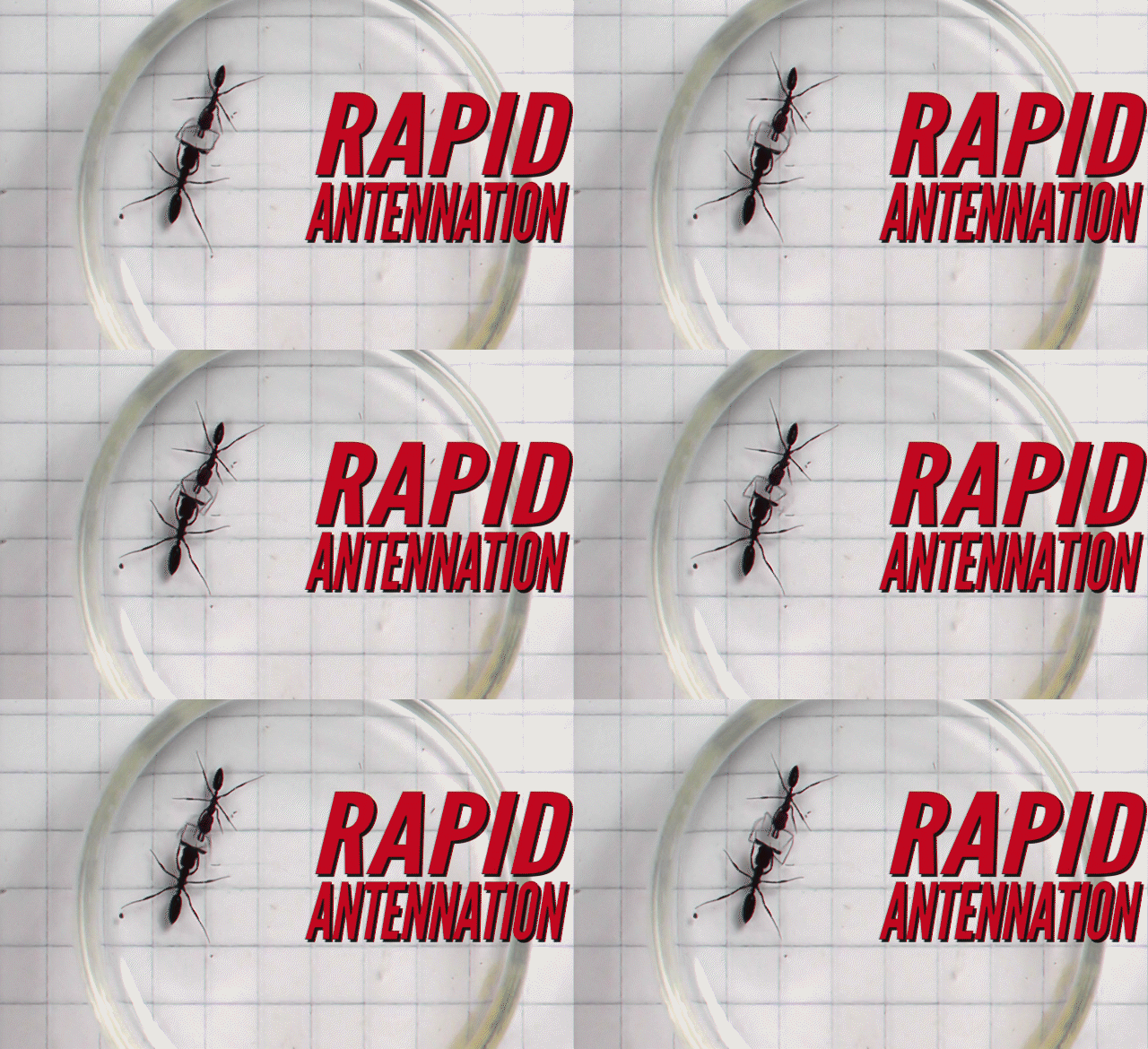
Ant colonies are governed by a strict social order, so members of a colony are destined to perform specific tasks. In the case of Odontomachus ants, status is conferred based on their fighting ability. These rapid antennal attacks, called rapid antennations, determine which ants will have to perform the most menial tasks. Thus, the ants will fight until one of the combatants admits defeat and decides that going in search of food is less arduous than having their head hammered with antennae. The victors therefore remain in the nest to care for the colony, while the losers must venture outside to collect food.
This type of confrontation had already been observed, but no one had measured the speed of these antennal strikes. Scientists from the University of Illinois and North Carolina State University therefore used slow-motion video to observe worker ants of the species Odontomachus engaging in antennal battles. They observed four species of Odontomachus ants to measure the speed at which they exchanged blows. The slowest and largest of the four species, Odontomachus rixos, delivers "only" 19.5 strikes per second. The fastest ant in the study is Odontomachus brunneus, which is capable of delivering up to 41.5 antennal strikes per second.
Although they possess powerful mandibles capable of killing instantly, these ants do not use their jaws in duels. Indeed, since the goal of combat is social dominance, the ants do not seek to physically injure a member of the colony; this is why they only use their antennae to "box." Ants are not the only species that engages in socialized aggression. Many animals demonstrate a propensity for violence as a means of asserting their authority. Lions, for example, fight to determine who owns prey. These conflicts contribute to the formation of a natural hierarchy that favors the strongest members of a group, which, over time, improves the overall physical condition of the group's members.
Source: http://sciencepost.fr/2016/02/fourmis-se-battent-duel-asserter-domination-sociale/
March 2016
"In 2012, researchers showed that the venom of Pachycondyla sennaarensis inhibited the growth and caused the death of cancerous breast cells, without affecting non-cancerous cells. The toxins responsible for this effect still need to be isolated."
Science & Vie No. 1182
February 2016
Worker ants in Florida have a habit of creating colonies with a complex architecture, but the reason for the complexity of this architecture is still unknown.

Florida worker ants create colonies or nests that are architecturally stunning, according to Walter Tschinkel. He placed molten metal or plastic in abandoned underground nests to get a sense of their multi-layered complexity. For reasons still unknown, Florida worker ant (Pogonomyrmex badius) colonies abandon their current colonies once a year and excavate a new one. At a study site Tschinkel calls "Ant Paradise," the colonies relocate approximately 2 to 6 meters from their previous locations.
This researcher and his students at Florida State University found no pattern to explain these relocations. It's not a need for tree shade or being dangerously close to neighboring colonies. Furthermore, the new colonies resemble the old ones. The nest looks like a series of interconnected chambers that descend into spiral tunnels, creating more chambers below.

And the ants dig their nest at a very rapid pace. The colony sends out several hundred worker ants to excavate the new nest. A colony, typically composed of 4,000 ants , can dig and move into the new colony in 7 days. During the move, the term "worker ants" truly comes into its own. These ants make constant trips back and forth between the new and old colonies. They transport their queen, hundreds of larvae, and young ants . They also carry the seeds and food they have collected. And these ants even move their charcoal, but what they do with it remains a mystery.
These ants strip pine needles and other pieces of charcoal from around the entrance to their nests. Sometimes, a large colony can collect up to 70,000 pieces of charcoal. Researchers have offered several explanations for the purpose of this charcoal, but they haven't found anything conclusive. It could serve as insulation, deter foreign ants, collect rainwater, or even heat the nest. But charcoal is just a small guess compared to the other behaviors of these worker ants . Ants are a collective species. Their queen produces the offspring, but she doesn't have a plan in mind. This means that these worker ants accomplish all these tasks without a leader, a plan, or even established instructions. And they can excavate a new nest entirely in the dark, as if there were automatic processes built into their behavior. Along with bees, ants are one of the most fascinating species to observe.
Source: https://actualite.housseniawriting.com
January 2016.
This article is taken from issue 828 of the monthly magazine Sciences et Avenir.
ENTOMOLOGY . A drug used to treat bipolar disorder in humans radically alters… the role of ants within a colony. While the relationship between behavior and DNA remains poorly understood in these insects, epigenetics, which refers to the effects of the environment on gene expression, could nevertheless be a major factor. These are the conclusions reached by a team from the University of Pennsylvania (USA), echoing the ongoing ethological debate between nature and nurture in animals. In this study, the researchers focused on carpenter ants of the genus Camponotus. These ants are divided into two castes: the “minors,” the workers that collect food, and the “majors,” the soldiers that protect the anthill. The scientists injected several compounds affecting histones—proteins involved in gene regulation and activation—into their brains. Depending on the alteration performed, they then noticed that the "major" ants began to dig in search of food, a task that is not usually theirs! While the "minor" ants became more agitated than usual (see video below). This epigenetic modification therefore led to a complete reprogramming of their behavior, which was more pronounced in the younger subjects.
July 2012
“Nearly three years after an oil pipeline leak in the Crau plain (Bouches-du-Rhône), vegetation is gradually reclaiming its territory. And to help it, CNRS researchers had the idea of using… ants, of course! Last autumn, they planted fertilized Messor barbarus queens in the soil. These will give birth to thousands of worker ants which, by carrying seeds back to their nest, should promote the spread of plant species in this unique ecosystem in Europe.”
Science & Vie No. 1138
English-language reports on ants:
Natural World: Empire of the Desert Ant
A captivating report on honeypot ants capable of storing very large quantities of food in their incredibly extensible abdomens in order to survive during periods when food becomes even scarcer in desert areas.
Planet Ant – Life Inside The Colony
Among ants, leafcutter ants are perhaps the most fascinating and highly evolved. This documentary discusses them extensively but also takes the opportunity to provide valuable information about ants in general. A must-see.
Glands in Ants
For communication, the secretion of antibiotics, pheromones, trails or passports and more, ants have at least 75 different exocrine glands*!
Trail pheromones are extremely effective at minute concentrations. For example, 1 milligram of Atta ant trail pheromone would be enough to mark the Earth three times!
*secreting substances out of the body
Parasites
Some myrmecophilous beetles are capable of mimicking the pheromones and behavior of ants during trophallaxis (food exchange). They can thus obtain food from the worker ants on demand!
Food Transportation Organization
How do ants organize themselves to transport heavy loads? Several methods exist, but a 2015 study demonstrates specific organizational mechanisms. For example, it's assumed that the more numerous the ants, the more their collective intelligence develops. In reality, a small group of ants working to move heavy food must agree on the direction to bring it back to the nest. Unable to follow a direction and pull the food simultaneously, the ants rely on a leader who ensures the direction is respected. She pulls and directs the food so that the other workers follow. But if the load is too heavy and there are too many workers to pull it, they will no longer be able to effectively follow the leader. Are small groups the most efficient?
Full article in English: http://www.popsci.com/crazy-ants-cooperate-carry-food