Leafcutter ants, the best-known species of which is Atta cephalotes, are among the most fascinating creatures on the planet. Fourmiculture invites you to discover them through this blog, which will allow you to develop new knowledge about these extraordinary ants.
If you wish to purchase Atta cephalotes leafcutter ants, check our available stock on the website or contact us.

Blog presentation:
This blog is dedicated to the rearing of Leafcutter Ants of the species Atta cephalotes. It will be updated regularly with new information on the development of our colony, our observations, and our discoveries. We are starting the colony with a queen, a few workers, and a symbiotic fungus. This will allow you to observe the development of this colony and better understand its needs and behavior. The ant breeder is Yvain Samuel, head of Fourmiculture.
The photos belong to Fourmiculture and may be distributed for non-profit purposes in exchange for a link to this page.
Species presentation:
Leafcutter ants comprise several species common in South America and the southern United States. The best known are Atta cephalotes and Acromyrmex octospinosus. They are commonly called "Leafcutter ants," but also "Fungus Gatherers," "Defoliators," or even "Parasol Ants." This is because they leave the nest in large numbers to cut and collect various plant materials, especially leaves, which they carry above their heads back to the nest.
(The following photo is royalty-free)

However, ants are unable to feed on leaves directly. They live in symbiosis with a fungus, often referred to by its Latin name. This is actually a type of mycelium (the underground, fibrous part of fungi). The ants deposit plant material on this fungus, which then feeds on it and grows. Very quickly, the fungus develops edible (gongylidia) for the ants. This constitutes the almost exclusive food source for Atta and Acromyrmex ants, supplemented only by the sap of the plants they cut. The larvae are also fed these fungal outgrowths.
The smallest workers, often called "gardeners," specialize in caring for the fungus. They prune it, protect it from other fungi and infections with antibiotics produced by their bodies, and re-inoculate the fungus with their excrement.
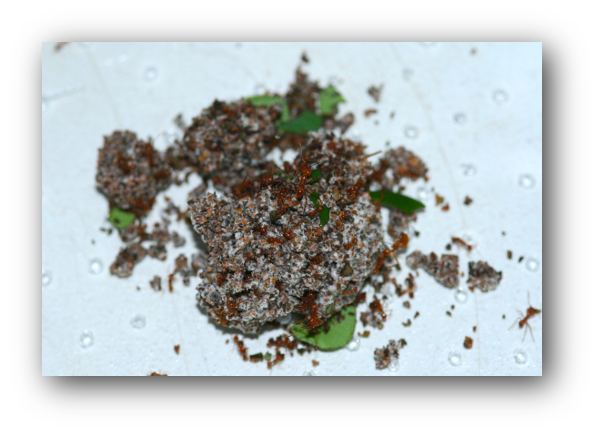
This is a very close symbiosis. The ants are unable to live without the fungus because it is their tool for digesting their food externally. And the fungus cannot survive more than a few days without the ants.
This highly developed micro-agriculture was invented long before humans, around 60 million years ago by ants.
The fungus's growth depends on the food supply and the number of worker ants tending it. The fungus can therefore regulate the colony's growth, but the opposite is usually true: a small colony can only care for a small mycelium, and the queen regulates egg-laying to prevent the population from increasing too rapidly relative to the available food.
Raising leafcutter ants:
Atta cephalotes and Acromyrmex octospinosus cannot be raised in typical artificial ant farms. They require a large open space to allow the fungus to grow. This space must be enclosed but allow oxygen to enter and CO₂ produced by the fungus to escape. High humidity is also necessary.
However, the mycelium is sensitive to the slightest draft and excess humidity such as condensation and direct contact with water.
Since these conditions are sometimes contradictory, it can be difficult to bring them together. Fortunately, once this is done, raising leafcutter ants proves quite simple.
Next, a feeding area connected to the main enclosed space allows for the deposit of food and the removal of waste. There are no special requirements for this part of the nest, but it may be beneficial to provide them with an additional enclosed space for waste, separate from the open feeding area.
Part One of the Blog: Installing the Ants
July 5, 2012:
I received the ants from an experienced breeder. Originally, this colony of leafcutter ants came from South America. They arrived within 48 hours in a simple plastic box containing the colony, the fungus, and pieces of leaves.
Here is the planned installation:
– 1 large 20x20cm Plexiglas cylinder with 1 ventilated lid and 2 holes
– Ventilation shouldn't be too strong in order to maintain good humidity. One of the holes is blocked, and the top vent is covered with cotton. This is a good technique for gently ventilating the inside of the anthill.
– The bottom of the nest is covered with damp clay balls to maintain the humidity that the ants need.
– A round plastic box (petri dish) contains the colony and allows it to live in humidity without touching the ground which might be too wet.
A tube allows the ants to leave the nest and reach the feeding area, a large container used for depositing leaves and removing waste. The sides are covered with talc to prevent the ants from climbing.
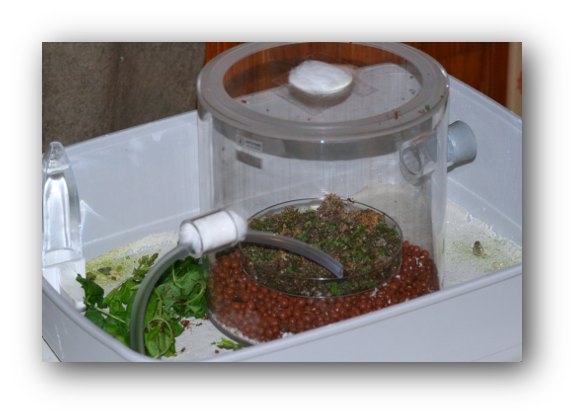
However, the fungus is in pieces and covered with bits of leaves. It really doesn't look to be in good condition… Here is the colony placed in its petri dish, which is itself placed in the cylinder:

Observing the colony, one thing is absolutely astounding: the size of the queen… She is one of the largest ants in the world, and you only realize how impressive it is when you see her! She measures approximately 3cm!
Atta cephalotes therefore exhibit incredible size differences, with workers ranging from approximately 3 to 20mm and a queen of 30mm…
Acromyrmex bees have a much smaller queen (approximately 12mm) and the largest workers do not exceed the size of the queen.
Here is the queen, head down in the picture, with a little worker on her back!

And here, a fairly large worker bee, with a very massive head housing powerful muscles that allow it to cut leaves into small pieces. You can see that there is brood (the white things). And the fungus still appears scattered.

To move around easily, not to slip in the glass tube that connects the nest to the harvesting area, and to descend easily along the wall, a cotton candle wick has been placed.
The queen takes the opportunity to go rock climbing!

July 10, 2012:
Let's start with some interesting photos. First, here's the fungus with the queen in the background, and some good-sized worker bees are already present.
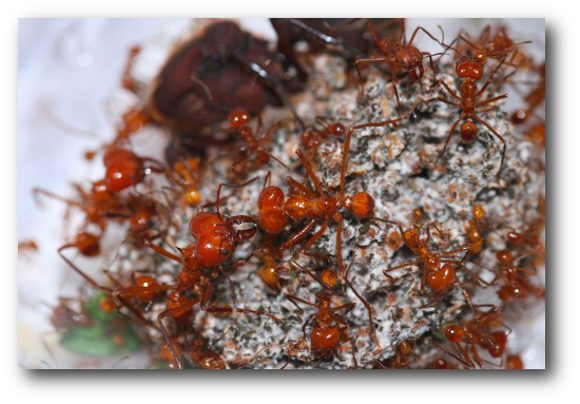
We can already observe the fascinating behavior of leafcutter ants during harvesting… Simply place some plants and workers of all sizes, except the small gardeners, will take charge of cutting pieces of leaf which will be brought back to the nest.
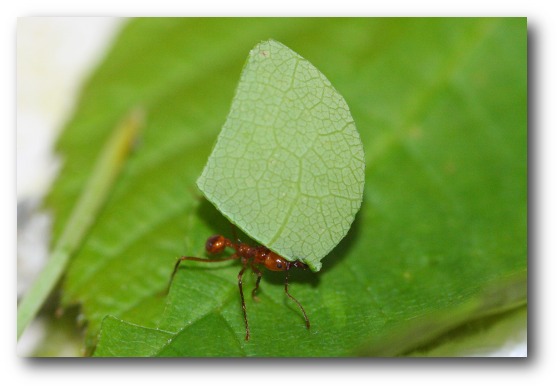
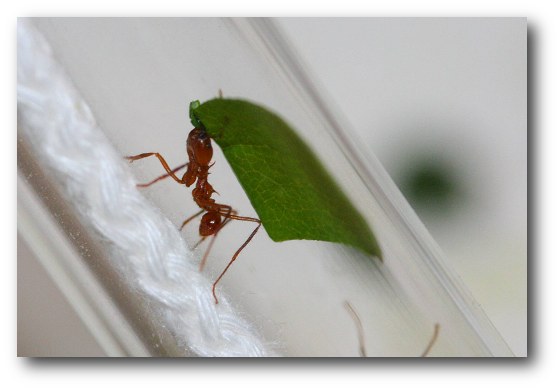
The leaves are brought back to the nest via the glass tube that leads to the nest:
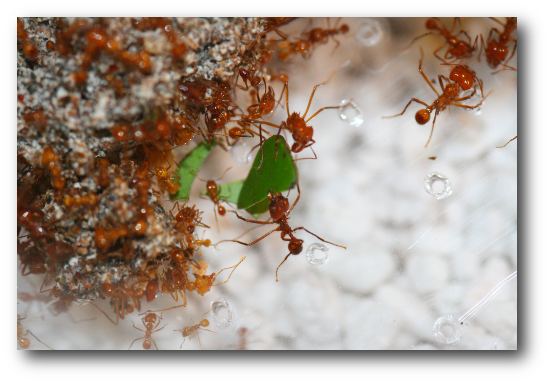
Once inside, increasingly smaller worker ants cut the leaf into tiny pieces to place on the mushroom.
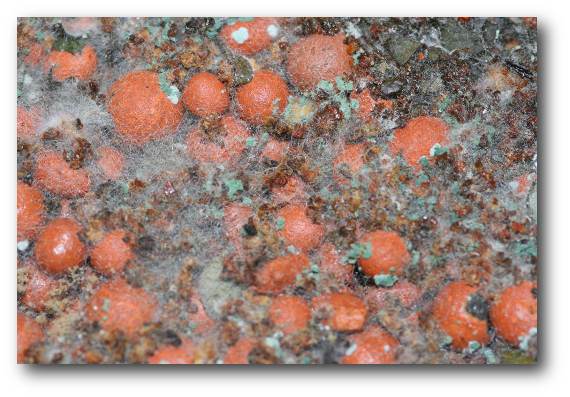
Unfortunately, mold has appeared under the petri dish in which the colony is placed. The moisture between the dish and the clay pebbles is the cause, and the nest must remain as clean as possible for the ants to survive.
The colony was then moved to a new Plexiglas cylinder, and the clay pebbles were replaced with perlite. The Petri dish was pierced with a hot needle to allow air circulation, and the dish was raised off the damp substrate.
It's a good start, but already the ants are leaving waste on the perlite, and that's worrying for the future…
January 2, 2013
Other molds and mites harmful to the colony appeared. The ants tended to leave waste on the perlite, and the humidity ultimately made the nest unhealthy. The conclusion was simple: no substrate should be used. The ants were relocated once again and placed in a clean, empty cylinder. A wall of moist Oasis foam provides the necessary humidity.
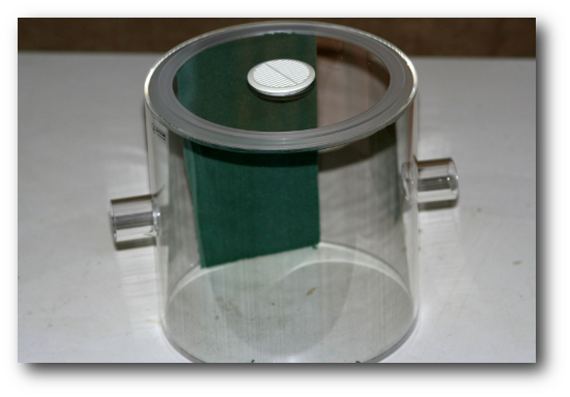
It is surprising to see that in a clean nest, without substrate, the ants systematically remove the waste from the nest, whereas with substrate, the ants tended to deposit it on top, creating mold!
The fungus resumed growth the very next day and the ants' activity greatly accelerated! Proof that this change was necessary.
Here is the ant colony a few days later.
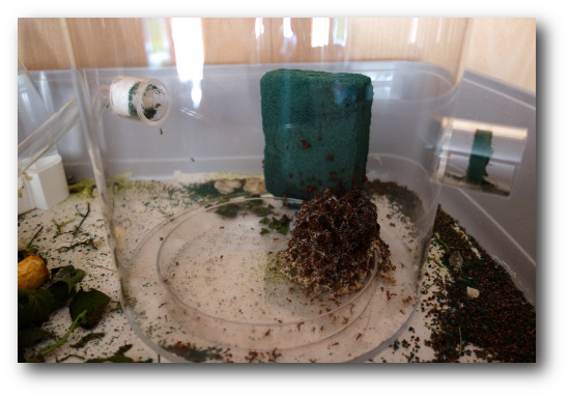
The hole on the right has been plugged with oasis moss. Ants can therefore dig through it if they need more air and less moisture. However, they seem to be trying to block this area even more, a sign of a significant need for moisture. The moss is therefore regularly moistened as well.
End of the experiment:
The colony developed successfully, eventually filling nearly half the nest with its mycelium. Regular births of soldiers were observed, each growing larger than the last. The colony was eventually sold to biology students in Versailles.