
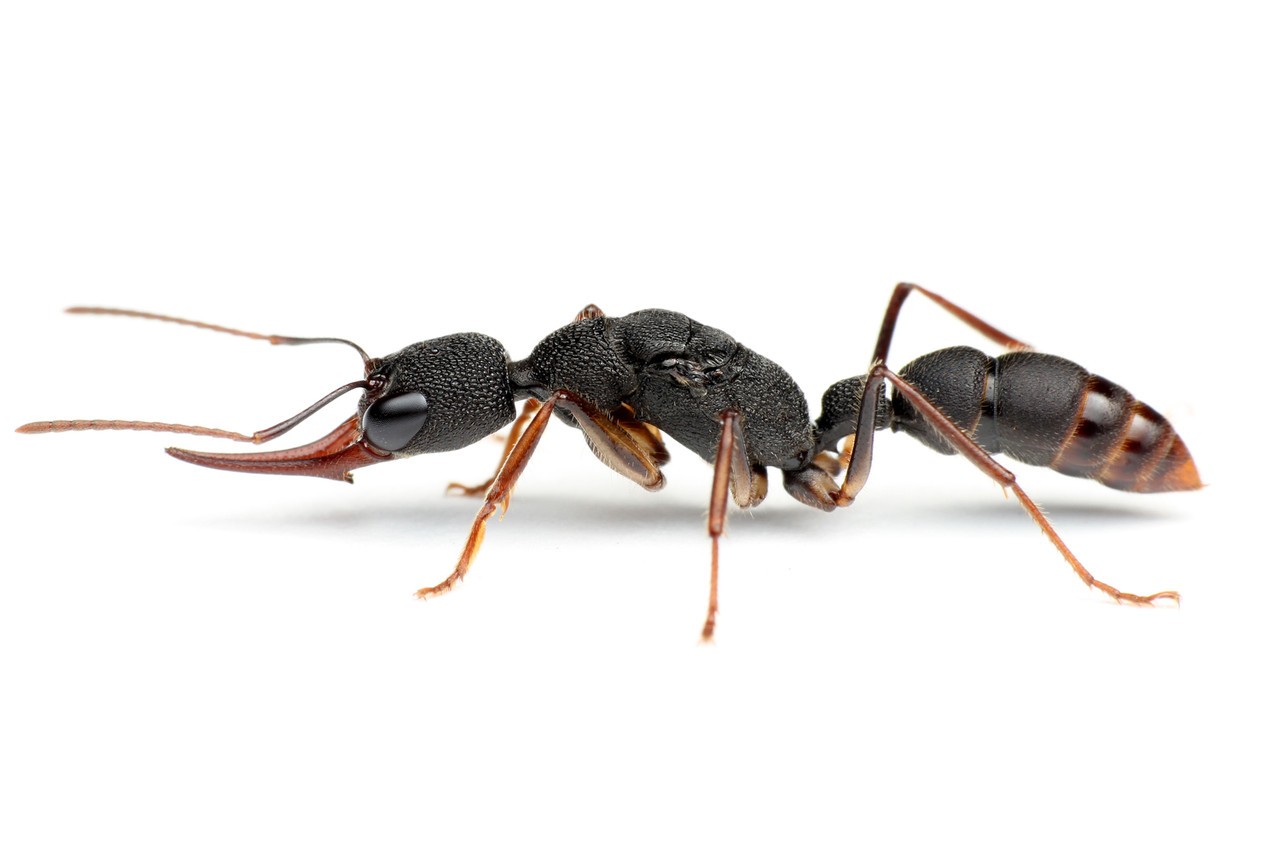
Harpegnathos venator – Colony with Queen and Workers
Colony of Harpegnatos venator, Primitive Asian hunting ant.
You'll love it:
- ❤️ Primitive morphology similar to a wasp and mandibles shaped like a toothed sickle (Harpa in Latin),
- ❤️ A good venomous hunter with excellent activity and strong aggression
- ❤️ Excellent vision and interaction with its environment,
- ❤️ Ability to jump to escape a threat,
- ❤️ Free and guaranteed safe delivery by courier within 24 hours (for purchases over €200 within the European Union)
Description
Discover Harpegnathos venator, the Asian Jumping Ant
Species presentation: Harpegnathos venator
Harpegnathos venator, also known as "jumping ants," are one of the most impressive and captivating species available for breeding. Without a doubt, one of our favorites at Fourmiculture. Native to the tropical regions of Southeast Asia, these ants are distinguished by their large, formidable, long, and serrated mandibles, as well as their highly developed eyes and a general morphology reminiscent of wasps, from which ants originally evolved.
Typical of a species that inherits primitive characteristics and possesses a brutal yet complex social organization, Harpegnathos venator can have several fertile queens in the nest, but only one will be dominant. Duels are possible to maintain the dominance of the queen and certain workers, sometimes resulting in the killing of an individual by a group or intimidation tactics to gain more food. The larvae feed directly on prey brought back to the nest without trophallaxis (food exchange by the workers).
This species is equipped with a stinger and stings its prey to paralyze it. Its sting is not considered dangerous or extremely painful, although we haven't found a volunteer to confirm this… Check your insect sting allergy beforehand, and to reassure your loved ones, consider our Ant Caver range, which features double escape prevention on the walls and via an island-like design surrounded by water.
With their long legs, Harpegnatos can leap several centimeters to escape danger. Their aggressive behavior, coupled with a social hierarchy typical of primitive species, makes them fascinating to observe and ideal for passionate breeders looking for a large, unusual hunting species.
With their relatively slow cocoon development and higher-than-average sensitivity (to stress and lack of humidity), raising this species can sometimes be disappointing for inexperienced breeders who might be tempted to place them in an unsuitable nest (Plexiglas or standard aerated concrete). We have therefore developed natural-type nests (Ant Caver range) with high humidity to perfectly suit the development of this species.
Harpegnathos venator also appreciates substrates such as extra-fine peat and builds its nest very well in the clay soil of its natural habitat in Asia; however, the lack of contrast between the ant and the substrate would be less attractive. We recommend either our Ant Caver range or a terrarium with, for example, a module of chambers made of well-dampened plaster or aerated concrete integrated against the glass of a terrarium (whose substrate is not intended to be excavated). This species can be an opportunity to create a magnificent, large tropical terrarium with an ant/cleaner/plant ecosystem. Providing a slight gradient of temperature and humidity is advisable to help it find optimal conditions.
However, provide at least a pinch of substrate (our Ants Caver nests generally contain a little sand) to help the larvae spin their cocoon.
Main features:
- Size: 12 to 17 mm approximately including the mandibles, little difference between queen and worker.
- Diet: Live prey (cockroaches etc.) or freshly dead prey, sweet liquids such as nectar or diluted honey.
- Difficulty level: Intermediate to advanced. Harpegnathos venator require a specific environment and particular attention to humidity; they are sensitive to stress.
- Nest type: Prefer spacious nests simulating natural cavities, with high humidity.
Recommended living conditions:
- Temperature: 24 to 28°C.
- Diapause: No diapause/wintering required.
- Humidity: High humidity in the nest.
- Nest recommendation: A spacious nest suitable for active tropical species. Harpegnathos venator appreciate natural substrates and the opportunity to explore in a biotope-type terrarium. To meet their needs while ensuring excellent observation, an Ant Caver-type nest is ideal. Initially, a tube with a plaster base (bamboo tube type) is also suitable.
Key features:
- Impressive abilities: Their rapid jumps, their ability to keep up with you from behind, attacking prey by following it and shaking their abdomen before diving on it make them particularly attractive to breed.
- Specialized mandibles and venomous stinger: Used to capture prey and defend themselves, their mandibles are formidable for capturing and immobilizing prey before stinging and paralyzing it. Harpegnathos demonstrates an exceptional adaptation to hunting.
- Dynamic social hierarchy: Unlike other species, worker bees can transform into "pseudo-queens" in the absence of a queen, creating a fascinating social dynamic. The queen, whose presence is guaranteed in our colonies, is difficult to spot because her morphology is very similar to the workers (although she does have wing scars).
- Active behavior: Harpegnathos venator are formidable hunters, perfect for enthusiasts wishing to observe captivating interactions.
Ethical commitment and quality:
At Fourmiculture, we place paramount importance on the well-being of our colonies. Our Asian ants are imported by direct flight, a method that significantly reduces stress and mortality associated with shipping by parcel.
Upon arrival, they are acclimatized in our facilitiesunder perfectly controlled climatic conditions to guarantee their stability and health. This approach allows us to verify the presence of a fertile queen and assume the risk of losses on our end.
Express delivery is mandatory! Whether you choose this option or not, we will always ship this species via express delivery within France at no extra charge for its well-being. For the rest of the world, please select the fastest available carrier.
⚠️ Important : This species is exotic and its release into the environment is prohibited. However, this species does not pose an invasive risk due to its small population size and limited adaptability.
Distribution of Harpegnathos in the wild:
Southeast Asia, including Thailand, Vietnam, etc. This species is a good builder and it builds its nest in very damp soil in order to form cavities in which to live and store its cocoons.


Additional information
| Number of female workers | 1 Queen + 1 to 4 workers, 1 Queen + 11 to 25 workers, 1 Queen + 26 to 50 workers, 1 Queen + 5 to 10 workers |
|---|