


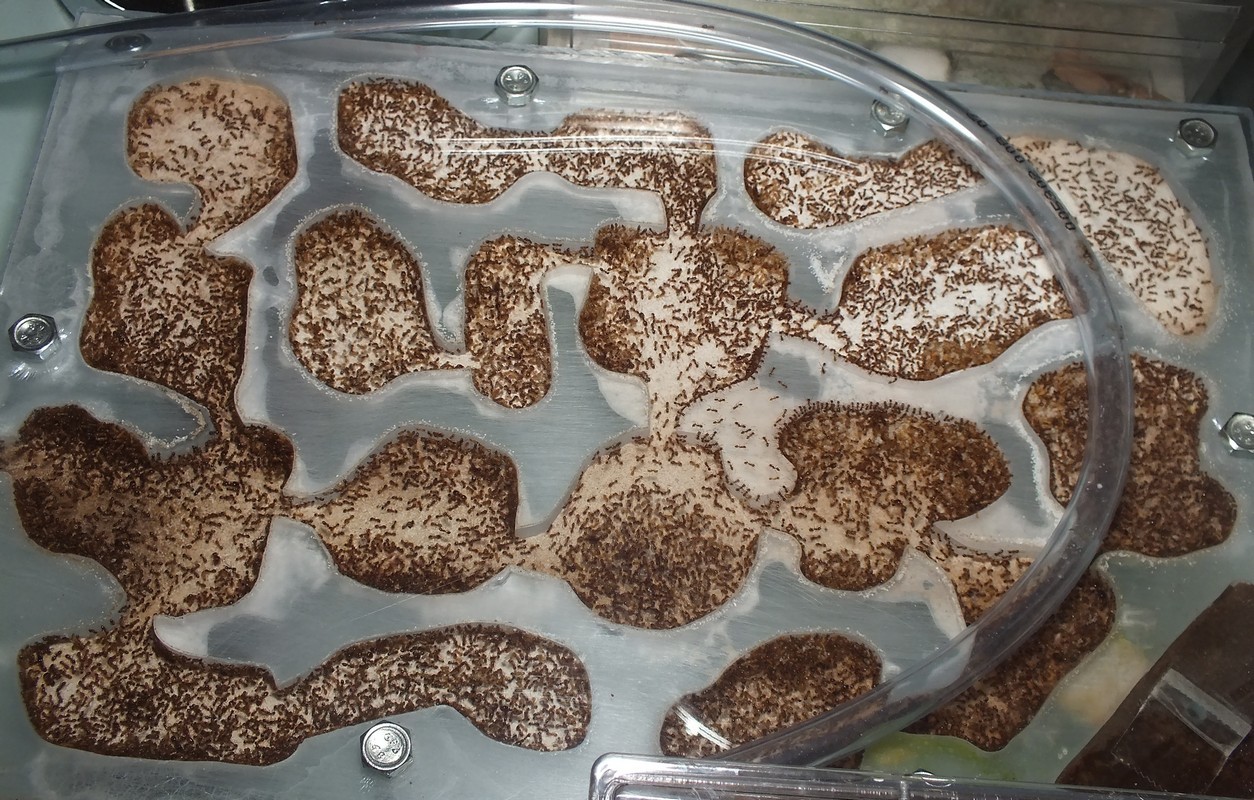

Pheidole pallidula – Colony with Queen and Workers
Price range: €9.90 to €25.00
Pheidole pallidula is the only French species to possess true soldiers! Its rapid development and constant activity without hibernation make it a species worth knowing about despite its tiny size. Extremely voracious, Pheidole is aggressive and constantly seeks out protein sources for its diet.
Description
Pheidole pallidula is covered by the Fourmiculture Charter:
1. Establishment approved by the Veterinary Services and the Prefecture, in possession of the certificate of competence for the sale of ants (Decision No. 2016195-0002 of the Departmental Directorate for the Protection of Populations),
2. Free Guide to the Perfect Ant Keeper and health record provided,
3. Ants guaranteed free of mites and parasites,
4. Health demonstrated by the queen laying eggs and the presence of brood upon shipment,
5. No "boost" (addition of brood or external workers to sell colonies faster),
6. Guaranteed delivery in good health: partial refund in case of loss of workers, full refund in case of loss of the queen (if delivered within 48 hours),
7. Shipping possible from -12°C to +40°C thanks to our optional insulated packaging,
8. Species present in France, non-invasive and not threatened,
9. Colony buyback and costs covered if you wish to part with it (see conditions).
______________________________________________________________________________________________
In Pheidole pallidula, unlike many species that have workers of all sizes (Messor, Camponotus) or of the same size (Lasius, Crematogaster…), two distinct castes are observed: workers and soldiers, dedicated to the defense of the colony and the storage of food in their abdomens. They can also be referred to as soldiers because all the workers are female.
In Pheidole pallidula, the presence of soldiers, its record development and its reckless behavior make it a formidable species for other ants and a captivating subject of study for ant enthusiasts.
Pheidole pallidula's distant tropical origins allow it to remain active and grow at the same rapid pace all year round. Don't hesitate to keep it at 27°C 365 days a year!
It only takes three weeks to develop from egg to adult. But since worker bees only live for a few months, the queen must lay eggs en masse to ensure the survival of her offspring. Imagine a colony of 50,000 worker bees. That's the number of eggs she must lay before the workers die of old age!
Caution: Pheidole pallidula ants are so small and bold that they constantly try to escape their nest. Be vigilant and don't hesitate to contact us to check if your nest is suitable. Regarding feeding, an observation area is recommended for its effectiveness. Indeed, Pheidole pallidula escapes are possible if your nest is unsuitable. Be wary of plexiglass models, especially those from other countries, which are assembled without glue. Also, pay attention to the foraging area, which must have either our special treatment or high walls that you can treat yourself. Oil is not recommended. It's best not to take any risks with this small but bold species.
As for food, Pheidole pallidula is so small that it risks drowning in sugary liquids. Don't hesitate to add a little cotton wool to the liquids to avoid any risk, or offer very small quantities. Pheidole pallidula will also readily eat insects, canned tuna, and other sources of solid protein.
Once the right conditions are in place, the colony will thrive and provide excellent observations. It's a species we greatly appreciate in captivity despite its few limitations. Here's a presentation video with a Pheidole pallidula breeding guide by Steve:
Information about Pheidole pallidula :
Minor worker size: 2-3 mm
Soldier worker size: 3-5 mm
Queen size: approximately 7-8 mm
Recommended temperature: 27°C during the day and 22-24°C at night
Overwintering: None, not recommended; if necessary, short and not too cold.
Humidity: Medium, do not allow to dry out
This species is incompatible with gel ant farms, like all colonies with a queen!
The assembly of the artificial ant farm and its anti-escape system must be carefully checked for this very small species.
| Latin name: |  |
Pheidole pallidula |
| Common name: |  |
None |
| Taxonomy: |  |
Subfamily: Myrmicinae Genus: Pheidole |
| Difficulty level |  |
(2) A species that is difficult to escape from, has food requirements and is sensitive to temperature |
| Distribution: |  |
Southern Europe, North Africa |
| Habitat: |  |
Sandy areas, exposed to heat |
| Number of queens: |  |
polygynous (can theoretically accommodate several queens per colony, generally known with 1 queen per colony) |
| Queen : |  |
Size: 7-8mm Color: Reddish brown |
| Female workers: |  |
Size: 2-4mm Colour: Black, reddish heads in soldiers. Lighter colouring, even yellow depending on the colony and origin. |
| Soldiers: |  |
6mm |
| Males: |  |
Size: 4-6mm Color: black |
| Food : |
 |
Lots of protein, insects, meat, ham, fish, protein pellets, sweet jellies, sweet liquids, honeydew, fruit, some seeds. |
| Humidity : |  |
Hunting area: 30–50% (low to medium) Nest: 50–70% of the area (medium to high) |
| Temperature: |  |
Foraging area: 25 – 30°C Nest: 21 – 28°C (27°C for optimal brood growth. A lower temperature leads to stagnation). |
| Hibernation: |  |
This species, which is optional, is one of the few that can grow without limit in winter at 27°C. |
| Type of natural nest: |  |
It builds its nest in the ground, under stones, and digs tunnels in sandy terrain in particular. |
| Type of anthill: |
 |
Can penetrate aerated concrete and plaster. Plexiglas is recommended, or hardened plaster, mortar, glass, etc., provided there is sufficient humidity. |
| Size of the anthill: |  |
4 to 8mm high, approximately 5 to 20cm to start. |
| Substrate: |  |
Not necessary, but likes to dig. Mixture of potting soil and sand, oasis moss, etc. |
| Plants: |  |
Not necessary, but commonly lives in contact with various herbs and plants. |
| Decoration: |  |
Sand, rocks, dry wood |
| Behavior : |  |
Aggressive, high recruitment and activity in case of aggression |
| Development: |  |
Swarming occurs from May to September. The queen establishes her colony alone. The workers emerge in 28 days. The colony reaches 10,000 workers or more. |
| Quantity sold: |  |
1 fertilized queen with brood and workers according to option. |
Photo 2: © Elham Kashani Antweb.com Photo 1 & 3: © colonies.over-blog.com
Additional information
| Weight | 0.1 kg |
|---|---|
| Number of female workers | 1 Queen + 1 to 4 workers , 1 Queen + 11 to 25 workers , 1 Queen + 26 to 50 workers , 1 Queen + 41 to 80 workers , 1 Queen + 5 to 10 workers , 1 Queen + 51 to 99 workers |