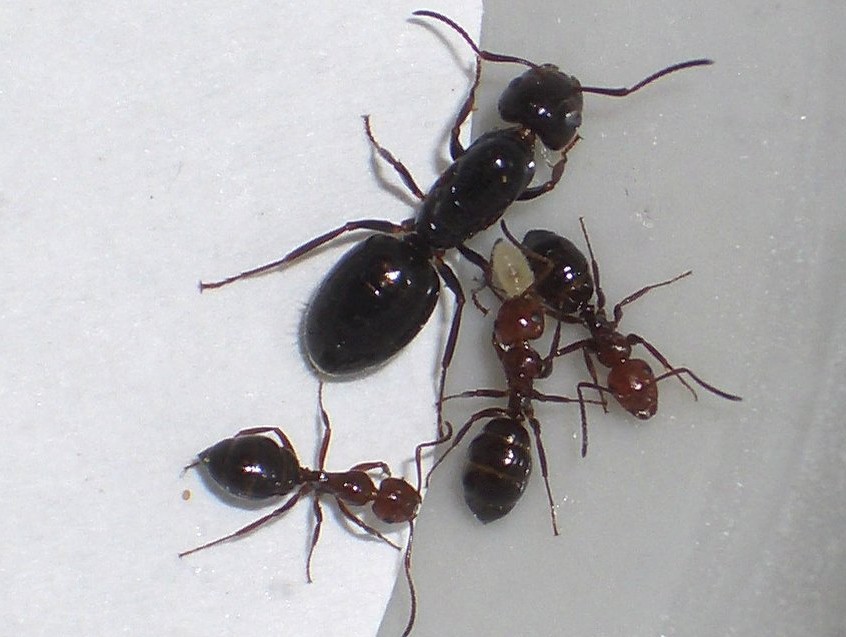
Camponotus lateralis with queen + 1 to 4 workers
19,00€
A small, two-toned Camponotus wasp with some size differences between workers. Very low humidity requirements. Prefers to live in wood.
Out of stock
Description
Camponotus lateralis and our Ant Charter:
– Raised by a specialist under optimal conditions, guaranteed parasite-free,
– Health demonstrated by the queen laying eggs and the presence of brood upon shipment,
– No "boost" (addition of brood or external workers to sell colonies faster),
– Guaranteed healthy delivery: partial refund in case of worker loss, full refund in case of queen loss (if delivered within 48 hours),
– Supplied with a care sheet and a health record,
– Species present in France, non-invasive and not threatened,
costs covered if you wish to dispose of it (see conditions).
This attractive Camponotus lateralis from southern France displays a coloration similar to Crematogaster and also prefers dry environments. It enjoys aphid honeydew and therefore all the sugary and protein-rich liquids that it stores in large quantities in its stomach. The swelling is particularly noticeable in this species.
Like most Camponotus species, major workers are present. These are large workers, almost as large as the queen, whose role is to store food and defend the colony. Their head coloration is striking, a vibrant red that is pleasing to observe.
Camponotus lateralis is commonly found throughout southern Europe and prefers to live in dead wood. Its colonies have relatively few workers, around 2000 at adult size. It can be kept in a Plexiglas nest without any problems, or in many other environments provided they are relatively dry.
Camponotus lateralis has very low humidity requirements, so the nest should only be very lightly moistened. However, no species can truly live in a completely dry nest.
Queen size: 7 to 10mm.
Worker size: 3 to 7mm.
Recommended daytime temperature: 27°C.
Nighttime temperature: 19 to 24°C.
Overwintering: 2 months at 10-18°C.
Food: sugary and protein-rich liquids, possibly insects and solid foods.