
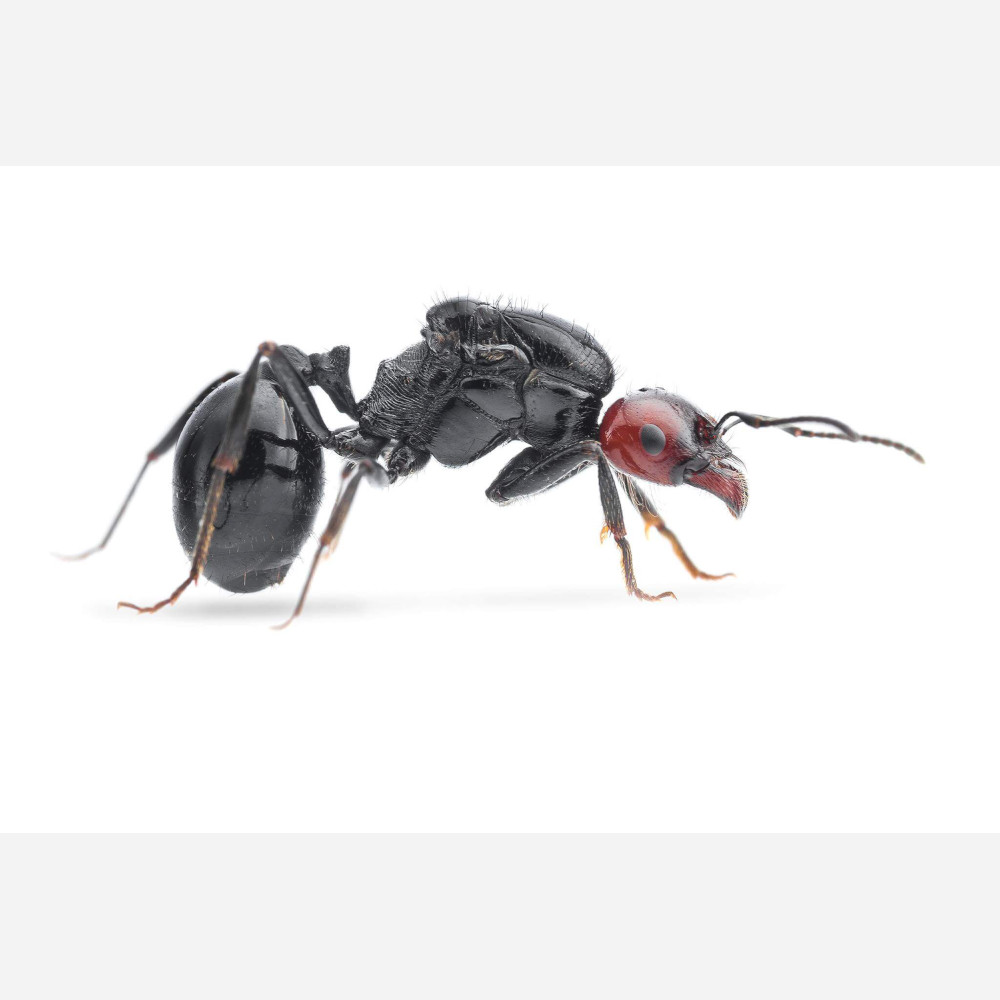
Messor angularis – Colony with Queen and workers
Messor angularis feeds on seeds, is very easy to feed and raise, and is ideal for beginners or for expanding your collection with an exotic species. Native to Africa, and Kenya in particular, it does not need to overwinter! An excellent alternative to Messor minor hesperius.
Description
Charter Fourmiculture for our Messor angularis Ants:
1. Establishment approved by the Veterinary Services and the Prefecture, in possession of the certificate of competence for the sale of ants (Decision No. 2016195-0002 from the Departmental Directorate for the Protection of Populations)
2. Free Guide to the Perfect Ant Keeper and health record provided,
3. Ants guaranteed free of mites and parasites,
4. Health demonstrated by the queen laying eggs and the presence of brood upon shipment,
5. No "boost" (addition of brood or external workers to sell colonies faster),
6. Guaranteed delivery in good health: partial refund in case of worker loss, full refund in case of queen loss (if delivered within 48 hours),
7. Shipping possible from -12°C to +40°C thanks to our optional insulated packaging,
8. Species, non-invasive and not threatened.
Messor angularis is an aesthetically pleasing, affordable, and easy-to-raise harvester ant species from Kenya that does not require hibernation !
Video from a Russian customer:
Description of the species Messor angularis:
Particularly easy to feed and raise, Messor angularis require little care and are a good size for observation with about 12mm for the queen, small minor workers of 4mm and larger workers that are born gradually as the colony grows.
The simultaneous presence of several sizes, from approximately 4 to 9 mm, makes Messor angularis unique. The largest workers have a massive, red head with powerful musculature that allows them to carry and grind even the hardest seeds; these are called major workers.
The queen is black on her body with a bright red head, like the most exceptional barbarus in colouring, but in a systematic way!
Optimal growth is achieved at around 27°C during the day; no wintering period is necessary, as the temperature does not fall below 20 to 25°C in winter in Kenya.
Feeding primarily on seeds that the worker ants store in dry chambers, Messor angularis (and other Messor species) can live off their reserves for months without any problems. This greatly simplifies their rearing. Observations are frequent, and you can watch the ants prepare a paste from the seeds to eat three days later.
Messor angularis is a species very well suited to breeding and observation for beginners as well as for great enthusiasts who will obtain impressive colonies after a few years while ensuring a minimum of management.
The delivery of healthy ants is guaranteed by courier within 48 hours and for 3 days following delivery. We have developed special packaging for the safe (and environmentally friendly) transport of the ants to your home.
Breeding sheet on Messor angularis:
– Recommended rearing temperature: 27-28°C during the day and 20-25°C at night for optimal development
– Hibernation (Winter rest): None
– Humidity: Relatively low overall, but consistently high in a small area. All our ant farms are designed for this species.
– Waterer: Recommended in the feeding area (special waterer, water droplets, or damp cotton) but optional if the nest humidity is adequate.
– Light: Never direct sunlight. Avoid strong light and artificial light bulbs. Suitable heating for Messor angularis is a ceramic heat emitter or a heat mat.
– Queen size: Approximately 12mm
– Worker size: 4-9mm
– Color: Black; large workers and the queen have reddish heads.
– Castes: Presence of small workers (minors), large workers with developed, colorful heads and powerful mandibles (majors), as well as a whole range of intermediate sizes (medias).
– Estimated development rate: A few dozen workers the first year, up to a few hundred the following year (depending on conditions).
– Habitat type for rearing: Any type of artificial ant farm with a mineral layer and fairly high chambers, like all ant Fourmiculture.
Did you know that, to summarize:
– The lifespan of the queen, and therefore the colony, reaches 15 years
– You only need to feed your ants once a month because they store the seeds they eat
– The queen lays eggs that become larvae, then pupae, and finally adults in just 30 days
– Messor ants are capable of hunting and consuming insects much larger than themselves
– Ants are fascinating creatures to observe, and more and more individuals and schools are discovering them!
Behavior of Messor angularis:
As the colony grows, increasingly larger worker ants appear and help to grind hard seeds. Development accelerates sharply from the second year onward, quickly leading to very active and large colonies. The queen ant regularly lays clusters of eggs that will hatch into small larvae. After several molts, these will become pupae (almost adult, white ants) which will then complete their transformation into adults. The entire cycle takes about a month, longer if the temperature is low.
The entire colony feeds on seeds. The workers will hull and chew the seeds for about three days to make an edible paste often called "ant bread."
The ants will live in the humid part of the anthill while the seeds will be stored in the dry area to prevent them from germinating.
Photo: Copyright Antsatan.pl
Additional information
| Weight | 0.1 kg |
|---|---|
| Number of female workers | 1 Queen + 1 to 4 workers, 1 Queen + 20 to 40 workers, 1 Queen + 41 to 80 workers, 1 Queen + 5 to 10 workers |